
Pennsylvania PennDOT Motorcycle Practice Test 6
Test 6 of 6. Pick an answer for each question to see if it is right and why; your score appears at the end. You need 15 correct answers to pass, the same ratio as the real Pennsylvania test.
- Questions18
- Correct to pass15
- Passing score83%
- Minimum age16 years
-
1. Your vehicle is burning at the roadside. How far away should everyone keep?
Show answer
Answer D: At least a hundred feet away from the vehicle and upwind, out of the drifting smoke
Burning vehicles give off toxic smoke and parts such as tires and struts can burst, so keep a long distance and stay upwind.
-
2. You back into an unattended parked car in a lot and cause visible damage. What must you do?
Show answer
Answer A: Try to find the owner, or leave a note with your name and contact details, and report the crash
Hitting an unattended vehicle carries the same duties as any crash. Leaving without identifying yourself is a hit-and-run offense.
-
3. What additional penalty applies to a Pennsylvania DUI conviction committed with a minor occupant, under 18, riding in the vehicle?
Show answer
Answer B: An additional penalty is imposed on top of the underlying tier's sentence
Pennsylvania law imposes an additional penalty when a DUI violation is committed with a minor occupant under 18 in the vehicle, on top of whatever the underlying BAC tier already requires.
-
4. Which of these is a known cause of a high speed wobble?
Show answer
Answer C: Incorrect tire pressure or a load carried too far back and too high
Wobble is usually traced to tires, wheels, loading or poorly mounted accessories such as a windshield or fairing, so check pressures and how the machine is loaded.
-
5. What must a Pennsylvania Class M applicant under 18 complete before the road test and license?
Show answer
Answer A: Six months holding the permit, 65 hours of skill building and the Pennsylvania Motorcycle Safety Basic Rider Course
A Pennsylvania Class M applicant under 18 must wait six months from the permit issue date, certify 65 hours of skill building and complete the Basic Rider Course, whose 15 hours count toward the 65.
-
6. You must park on soft ground or on asphalt softened by heat. What should you do about the sidestand?
Show answer
Answer A: Put a flat, firm object under the stand to spread the load
A sidestand concentrates the weight of the machine onto a very small area, and on soft ground it sinks in until the motorcycle falls over.
-
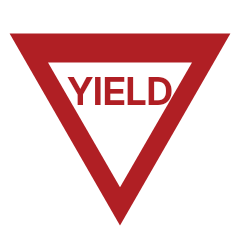
7. A driver passes this sign on an entrance ramp while merging onto a freeway. Who has priority?
Show answer
Answer B: The traffic already traveling on the freeway
The sign places the duty on the entering driver, who must adjust speed and fit into a gap without forcing through traffic to brake or swerve.
-
8. What is the correct body position for riding over a bump or an obstacle?
Show answer
Answer B: Rise slightly off the seat with your weight on the footrests, absorbing the shock with knees and elbows
Coming slightly off the seat lets your legs and arms work as extra suspension instead of transferring the impact through your body and the handlebars.
-
9. The driver ahead of you is straddling the lane line and is not signaling. How should you respond?
Show answer
Answer B: Stay back until you can see which lane that driver will take
A vehicle astride the line could move either way, so the only safe place is behind it where both possibilities are still covered.
-
10. What penalty applies to a first offense of illegally operating a Pennsylvania vehicle that is required to have an ignition interlock device but does not?
Show answer
Answer C: A fine of 300 to 1,000 dollars and up to 90 days imprisonment
A first offense of operating a Pennsylvania vehicle without a required ignition interlock device carries a fine of 300 to 1,000 dollars and up to 90 days of imprisonment.
-
11. You are on a city street with two lanes in your direction, cars parked along the curb and driveways every few yards. Which lane is usually safer?
Show answer
Answer B: The lane farther from the curb, away from opening doors and vehicles pulling out
Most of the hazards on such a street come from the curb side, so the inside lane gives you more space and more time to react.
-
12. What happens to fines for violations such as speeding when committed in an active Pennsylvania work zone staffed by workers on duty?
Show answer
Answer D: They are doubled
Fines for a list of Vehicle Code violations, including speeding, are doubled when committed in an active work zone manned by workers acting in their official capacity.
-
13. What is the default Pennsylvania statutory speed limit in an urban district unless a different limit is posted?
Show answer
Answer B: 35 mph
Pennsylvania's Vehicle Code sets the default maximum speed in an urban district at 35 mph unless a different limit is posted.
-
14. The sun is low behind you and shining into the eyes of oncoming drivers. What should you do?
Show answer
Answer C: Turn on your headlights and expect oncoming drivers not to see you
Drivers facing the low sun may not see you at all, so make yourself as visible as possible and give way rather than insisting on your right of way.
-
15. When did Pennsylvania's law prohibiting text based communications while driving take effect?
Show answer
Answer D: March 8, 2012
Pennsylvania's anti-texting law took effect on March 8, 2012.
-
16. How many points does a Pennsylvania Move Over Law conviction add to a driving record?
Show answer
Answer B: 2 points
A conviction under the Pennsylvania Move Over Law adds 2 points to the driving record, on top of a summary fine that rises with repeat offenses.
-
17. On a narrow two-lane road a line of vehicles has built up behind you. What is the safe and courteous action?
Show answer
Answer D: Pull into a turnout or a safe wide spot and let them go by
A slow vehicle holding up a queue invites risky passing; using a turnout clears the road without anyone having to take a chance.
-
18. Why should a driver crossing several lanes change only one lane at a time?
Show answer
Answer B: Each lane has its own traffic and its own blind spot to be checked
Sweeping across two or three lanes means entering lanes you never checked, so each change gets its own signal, mirror check and head check.