
Pennsylvania PennDOT Motorcycle Practice Test 1
Test 1 of 6. Pick an answer for each question to see if it is right and why; your score appears at the end. You need 15 correct answers to pass, the same ratio as the real Pennsylvania test.
- Questions18
- Correct to pass15
- Passing score83%
- Minimum age16 years
-
1. Why are dawn and dusk especially difficult times to be seen on a motorcycle?
Show answer
Answer A: Low contrast light makes a small vehicle blend into the scene
In the flat light of dawn and dusk a motorcycle blends into its background, so bright color, reflective material and the headlight matter most at exactly those hours.
-
2. What happens if a Pennsylvania driver is stopped by police and cannot show a valid insurance ID card?
Show answer
Answer C: The officer cites the driver, and a conviction can suspend both the vehicle registration and the driver license
If a Pennsylvania driver cannot show a valid insurance ID card when stopped, the officer cites the driver, and a conviction can lead to suspension of both the vehicle registration and the driver license.
-
3. When downshifting as the motorcycle slows, what keeps the rear tire from skidding?
Show answer
Answer A: Easing the clutch lever out smoothly instead of releasing it abruptly
Letting the clutch out gradually lets engine speed and road speed match, so the rear wheel is not forced to slow suddenly.
-
4. Which Pennsylvania riders are exempt from wearing protective headgear on a motorcycle?
Show answer
Answer A: Riders over 21 who have either two years of riding experience or have completed an approved motorcycle safety course
Pennsylvania exempts a rider who is over 21 and who either has two years of riding experience or has completed an approved motorcycle safety course; helmets are otherwise required.
-
5. What happens when tires are driven underinflated for a long time?
Show answer
Answer D: They wear at the edges, they run hot and they are more likely to fail
An underinflated tire flexes too much, which wears the shoulders and builds up heat that can destroy the tire.
-
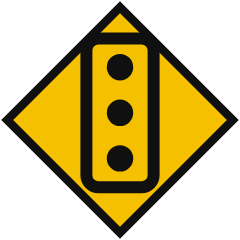
6. A driver passes this sign and the signal beyond it is already showing green. What is the safest response?
Show answer
Answer C: Ease off the accelerator and be ready to stop, because an indication that has been showing for a while is about to change
A signal that has been displaying the same indication for some time is close to changing, so arriving at a controlled speed with the brake covered is safer than accelerating to beat it.
-
7. You are riding at 30 miles an hour and need to move quickly to the left. What do your hands do?
Show answer
Answer D: Press forward on the left handgrip
Above a walking pace a motorcycle turns by leaning, and pressing forward on the grip on the side you want to go is what starts the lean.
-
8. Which blood alcohol range does Pennsylvania classify as general impairment?
Show answer
Answer B: .08 to .099
Pennsylvania splits DUI into three tiers, and general impairment covers a blood alcohol concentration from .08 to .099 for a driver of legal drinking age.
-
9. A snow squall cuts visibility to almost nothing while you are on a highway. What must you not do?
Show answer
Answer D: Stop in a travel lane and wait for the squall to blow through
A vehicle stopped in a lane in a whiteout is invisible until someone hits it. Slow gradually and keep moving until you can leave the roadway completely.
-
10. When may a Pennsylvania Class M learner's permit holder ride?
Show answer
Answer A: Only between sunrise and sunset
A Pennsylvania Class M learner's permit authorises riding only between sunrise and sunset, with no night time riding permitted.
-
11. What does an 8 restriction on a Pennsylvania motorcycle license mean?
Show answer
Answer A: The rider may not operate a motorcycle of more than 5 brake horsepower
Testing on a motorcycle of 5 brake horsepower or less places an 8 restriction on the Pennsylvania license, which bars the holder from operating anything more powerful.
-
12. What are the minimum liability coverage amounts required for a registered vehicle in Pennsylvania?
Show answer
Answer D: 15,000 dollars per person, 30,000 dollars per accident and 5,000 dollars property damage
Pennsylvania requires 15,000 dollars for injury or death of one person, 30,000 dollars where more than one person is hurt and 5,000 dollars for damage to the property of another person.
-
13. What mandatory minimum jail term does a first time Pennsylvania DUI offender face at the high rate tier, BAC .10 to .159?
Show answer
Answer B: 48 consecutive hours
A first offense at the high rate tier carries a mandatory minimum of 48 consecutive hours in jail, along with a 12 month license suspension and a fine of 500 to 5,000 dollars.
-
14. What does a 9 restriction on a Pennsylvania driver's license mean?
Show answer
Answer A: The rider is prohibited from operating a two wheeled motorcycle
Testing on a machine with more than two wheels adds a 9 restriction, which prohibits the holder from operating a two wheeled motorcycle.
-
15. What mandatory minimum jail term applies to a first time Pennsylvania DUI offender at the highest rate tier, BAC .16 or above?
Show answer
Answer C: 72 consecutive hours
A first offense at the highest rate tier carries a mandatory minimum of 72 consecutive hours in jail, more than the 48 hour minimum set for the high rate tier.
-
16. What extra consequence follows a second offense of operating a Pennsylvania vehicle without a required ignition interlock device?
Show answer
Answer D: A 1 year license suspension plus an additional 1 year of ignition interlock
A second offense of illegally operating a vehicle without a required ignition interlock adds a 1 year license suspension plus another 1 year ignition interlock requirement.
-
17. In an active Pennsylvania work zone, at what point does a speeding conviction bring an automatic 15 day license suspension even without a crash?
Show answer
Answer B: 11 mph or more over the posted limit
A driver convicted of exceeding the posted limit by 11 mph or more in an active Pennsylvania work zone automatically loses their license for 15 days, even absent a crash.
-
18. Why is smooth, early braking better than hard, late braking?
Show answer
Answer D: It keeps you in control and gives the driver behind more warning
Braking early and gently keeps the tires well within their grip and gives following drivers time to react to your brake lights.