
Pennsylvania PennDOT Motorcycle Practice Test 4
- Questions18
- Correct to pass15
- Passing score83%
- Minimum age16 years
-
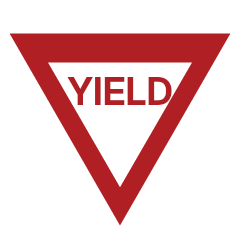
1. Apart from other vehicles, who else must a driver let go first at this sign?
Show answer
Answer A: Pedestrians and cyclists already in or entering the crossing
The duty to give way covers every road user who has the right of way at that point, including people walking or cycling across the driver's path.
-
2. Someone stops drinking heavily at two in the morning and drives to work at eight. What is true?
Show answer
Answer A: They may still be impaired and over the limit
The body removes alcohol at a slow, fixed rate, so a heavy night can leave a driver impaired well into the next morning no matter how they feel.
-
3. How does a wet road change the distance you need to stop?
Show answer
Answer C: It lengthens it, so you need a much bigger gap ahead
Water between the tire and the road cuts grip, so braking distance grows and the gap that works on dry pavement is no longer enough.
-
4. The crossing gates begin to lower while your vehicle is still on the railroad tracks. What should you do?
Show answer
Answer B: Keep going forward and push through the gate if it should block your way
Gates are made to break away, and driving forward off the tracks is far safer than staying between them or backing up.
-
5. You have had to leave the pavement onto a loose gravel shoulder and now need to stop. How should you brake?
Show answer
Answer D: Use both brakes gently and evenly, expecting a much longer stopping distance
Loose gravel cuts available traction sharply, so apply both brakes lightly and smoothly and allow far more room than you would need on pavement.
-
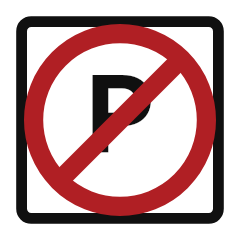
6. Why is this restriction so common beside fire hydrants, crosswalks and intersection corners?
Show answer
Answer C: To keep sight lines open and leave access for emergency crews
A vehicle left in those places hides pedestrians from approaching drivers, blocks the path of turning vehicles and can keep firefighters from reaching a hydrant.
-
7. A school sign combined with an AHEAD plaque, or with a plaque giving a distance in feet, forms an assembly that
Show answer
Answer B: warns of a school crossing located further along the road
The school advance crossing assembly is placed before the crosswalk to give drivers notice, while a different assembly marks the crossing itself.
-
8. On a rainy road, where can a rider usually find the best traction?
Show answer
Answer A: In the tire tracks left by the vehicles ahead
Vehicles ahead push water aside and keep their tracks clearer of oil, so those tracks generally give better grip than the rest of the lane.
-
9. It is very hot and a rider is tempted to take off the riding jacket. Why can that make the heat worse?
Show answer
Answer C: A bare arm in hot moving air loses fluid fast and burns in the sun
In hot, dry air a covering layer slows the evaporation of sweat and blocks the sun, so ventilated gear can keep a rider cooler and better hydrated than bare skin.
-
10. At the scene of a crash you were part of, what are you required to do besides stopping?
Show answer
Answer B: Give your name, your address and vehicle details, and help anyone who is hurt
Every state requires drivers involved in a crash to identify themselves and to render reasonable aid to anyone injured.
-
11. How much space should the leader of a group keep behind the vehicle ahead of the group?
Show answer
Answer D: At least the normal following distance a rider would keep when riding alone
Riding in a group does not shorten the space a motorcycle needs to stop, so the leader keeps the same cushion any rider would keep alone.
-
12. You cannot avoid an obstacle lying in the road. At what angle should you try to cross it?
Show answer
Answer D: As close to 90 degrees as possible
Meeting the obstacle squarely keeps the front wheel from being deflected sideways as it climbs over the edge.
-
13. You notice that the driver ahead of you is holding a phone to the ear. What should you do?
Show answer
Answer C: Assume slower reactions and leave extra space, or else hold back
A driver on the phone reacts late and misses things, so the safe response is distance rather than a lesson.
-
14. An emergency vehicle is stopped on the shoulder ahead with its lights flashing. What does the move over principle require?
Show answer
Answer D: Change lanes away from it, or slow down if you cannot
Move over laws ask you to give responders an empty lane, and where traffic or a two-lane road makes that impossible, you slow down instead.
-
15. You are following a large truck on a two-lane road and cannot see past it. What should you do before deciding to pass?
Show answer
Answer D: Drop back so that your view of the road ahead opens up
Distance is what buys you a view around a large vehicle, and no decision to pass can be made from a position where you cannot see.
-
16. You are making a legal U-turn at an intersection. Who has the right of way?
Show answer
Answer C: Everyone else, until your turn is complete
A U-turn crosses several paths at once, so you yield to oncoming vehicles, to crossing traffic and to pedestrians before starting it.
-
17. Your phone is in a mount on the dashboard rather than in your hand. What is true?
Show answer
Answer B: It still takes your eyes and mind off the road
A mount solves the hand problem but not the eye or the mind problem, and reading or tapping a mounted screen costs the same seconds of attention.
-
18. A large truck is passing you on a two-lane road. What is the safest thing to do?
Show answer
Answer C: Keep right in your lane and ease off the gas a little
Staying in your own lane and easing off shortens the pass without forcing you onto a soft shoulder or into the truck's path.