
Pennsylvania PennDOT Permit Practice Test 21
- Questions18
- Correct to pass15
- Passing score83%
- Minimum age16 years
-
1. A center lane is bordered by a solid yellow line on the outside and a broken yellow line on the inside, with left-turn arrows painted in it. How may you use that lane?
Show answer
Answer A: Only to make a left turn or to prepare for one from either direction
That marking identifies a two-way left turn lane, which may only be used for left turns or to prepare for a left turn and never for travel or passing.
-
2. How long should a glance at a mirror or an instrument take?
Show answer
Answer A: A brief glance of about a second, returning your eyes to the road at once
Checks should be quick flicks of the eyes. At highway speed, a few seconds with your eyes off the road covers a distance long enough for a hazard to appear.
-
3. Your vehicle is burning at the roadside. How far away should everyone keep?
Show answer
Answer D: At least a hundred feet away from the vehicle and upwind, out of the drifting smoke
Burning vehicles give off toxic smoke and parts such as tires and struts can burst, so keep a long distance and stay upwind.
-
4. A pedestrian signal changes to a flashing upraised hand. What does that indication mean?
Show answer
Answer C: Do not start crossing, but finish a crossing already begun
The flashing upraised hand is the pedestrian change interval: nobody may start to cross, but a pedestrian already in the crosswalk may continue to the far side or to a median.
-
5. You realize you have turned the wrong way onto a one-way street. What should you do?
Show answer
Answer A: Pull to the right, stop, and back into the street you came from when clear
Get out of the traffic stream first: pull right and stop, then back out into the street you came from once you can see it is safe.
-
6. In most states, when are headlights required apart from times of poor visibility?
Show answer
Answer A: From about half an hour after sunset to half an hour before sunrise
Most states require lights from about half an hour after sunset until about half an hour before sunrise, and some simply say sunset to sunrise; lights are also required whenever visibility is poor.
-
7. Your light turns green, but a vehicle from the cross street is still finishing a turn inside the intersection. What should you do?
Show answer
Answer B: Wait until that vehicle has cleared the intersection
A green indication lets you proceed only after yielding to pedestrians in the crosswalk and to vehicles already lawfully within the intersection.
-
8. What additional penalty applies to a Pennsylvania DUI conviction committed with a minor occupant, under 18, riding in the vehicle?
Show answer
Answer B: An additional penalty is imposed on top of the underlying tier's sentence
Pennsylvania law imposes an additional penalty when a DUI violation is committed with a minor occupant under 18 in the vehicle, on top of whatever the underlying BAC tier already requires.
-
9. You are parking on a hill where there is no curb, whether facing up or down. Which way should the front wheels point?
Show answer
Answer B: Toward the shoulder, so the vehicle would roll away from the traffic lanes
With no curb to stop the vehicle, the wheels are turned toward the edge of the road so that a runaway vehicle leaves the roadway instead of entering it.
-
10. How long should a young child ride in a rear-facing child seat?
Show answer
Answer D: Until the child outgrows the height or the weight limit of the seat
Rear facing is the safest position and should be kept until the child reaches the top height or weight allowed by the seat.
-
11. The red oil pressure warning light comes on while you are driving. What should you do?
Show answer
Answer C: Pull over safely as soon as possible and shut off the engine
Loss of oil pressure means the engine is no longer being lubricated and can be destroyed within minutes. Stop, shut down and check before restarting.
-
12. What is a good habit when you open the door on the traffic side of a parked car?
Show answer
Answer C: Use the hand farther from the door, which turns you to look back
Reaching across with the far hand rotates your body and brings the mirror and the road behind into view before the door moves.
-
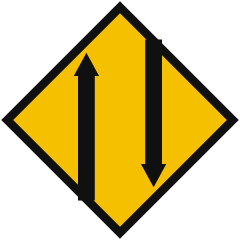
13. Which action becomes clearly more risky beyond this sign?
Show answer
Answer A: Using the left side of the roadway to overtake
With vehicles coming the other way on the same pavement, overtaking on the left needs enough clear road to pull out, pass and return, which is often not available.
-
14. A yellow sign reads SOFT SHOULDER. What is it telling you?
Show answer
Answer C: The shoulder may not carry the weight of a vehicle
A soft shoulder is unpaved and can let a wheel sink, so a driver who leaves the pavement there may lose control or become stuck.
-
15. The cars in front of and behind your parallel parked car have left you very little room. How do you get out?
Show answer
Answer D: Ease back and forth, turning the wheels each way, until you clear
Short movements with the wheels turned first one way and then the other walk the car out of a tight space without touching anything.
-
16. A parking space is marked with the international symbol of access. Who may use it?
Show answer
Answer A: Only a vehicle displaying the required placard or plate
Accessible spaces may be used only by a vehicle that displays a valid disability placard or plate, no matter how short the stop would be.
-
17. A driver extends the left arm out the window and bends it upward at the elbow. What does this signal mean?
Show answer
Answer B: A right turn
The left arm bent upward at the elbow is the standard hand signal for a right turn.
-
18. On an unlit road, about how far ahead do high beams normally let you see?
Show answer
Answer D: About 350 to 500 feet ahead of the vehicle
High beams light roughly 350 to 500 feet of road and low beams far less, which is why night speeds have to be chosen around the beam, not the limit.