
Pennsylvania PennDOT Permit Practice Test 20
- Questions18
- Correct to pass15
- Passing score83%
- Minimum age16 years
-
1. You stop at the curb on a busy street to let passengers out. What should you tell them?
Show answer
Answer A: To get out on the curb side, away from traffic
Passengers should always leave on the side away from moving traffic, which keeps both them and the door out of the travel lane.
-
2. When are the hazard warning lights properly used?
Show answer
Answer A: When your vehicle is stopped or barely moving and is a hazard
Hazard lights warn that your vehicle is an obstruction; they do not authorize illegal parking and they hide your turn signals while driving.
-
3. Which family of signs normally uses a rectangle that is wider than it is tall?
Show answer
Answer B: Guide signs, which name routes and destinations
Guide signs are laid out as horizontal rectangles because they have to carry route numbers, place names and distances side by side.
-
4. After a crash your door will not open and you need to get out of the car. What should you try?
Show answer
Answer B: Try another door of the vehicle, or a window that will still open properly
A jammed door is common after an impact, and the simplest escape is a different door or a window rather than forcing the damaged one.
-
5. Your steering suddenly feels light and unresponsive as you drive through standing water. What should you do first?
Show answer
Answer A: Ease off the accelerator and keep the steering wheel pointed straight
Those symptoms mean the tires are riding on a film of water, and gently lifting off the accelerator lets them settle back onto the pavement. Hard braking or sudden steering while hydroplaning can start a skid.
-
6. You are at a red light where right turns on red are allowed, you cannot see clearly, and the driver behind sounds the horn. What should you do?
Show answer
Answer C: Stay stopped until you can see that the turn is safe
Turning right on red is permitted, never required, so you wait until you can see that the way is clear no matter what the driver behind does.
-
7. A vehicle coming toward you has drifted into your lane. What should you do?
Show answer
Answer D: Slow down, sound the horn, flash your lights and steer to the right if possible
Moving right gives the other driver space to recover and keeps you out of the lane they are most likely to return to. Braking reduces the force of any impact.
-
8. An emergency vehicle with flashing lights and a siren is approaching from behind on a two-way street. What should you do?
Show answer
Answer C: Pull over to the right edge of the road and stop until it passes
Clearing a path by pulling to the right and stopping gives the emergency vehicle a predictable route, while stopping in mid-lane or inside an intersection blocks that path.
-
9. Why is it often safer to back into a parking space than to back out of one?
Show answer
Answer D: Because you leave the space going forward, with a clear view
Backing into the space puts the difficult maneuver where you are stopped and looking around, and lets you drive out facing the traffic and pedestrians.
-
10. A yellow horizontal rectangular sign showing one large arrow pointing left or right, facing traffic on the far side of a sharp bend, tells the driver
Show answer
Answer C: which way the roadway turns at that point
The large arrow sign is mounted on the outside of a sharp change in alignment so that a driver approaching head on immediately sees which way the road goes.
-
11. There is a stop sign but no stop line and no crosswalk. Where must you stop?
Show answer
Answer A: Before entering the intersection, where you can see cross traffic
With no line or crosswalk, stop before you enter the intersection at the point where you can see traffic on the cross street.
-
12. What does it cost a Pennsylvania driver to add the organ donor designation to a license or ID card when the photo is taken?
Show answer
Answer D: Nothing beyond the normal product fee
PennDOT charges no additional fee to add the organ donor designation when a driver's photo is taken at a Photo License Center.
-
13. A notification appears on your smart watch while you are driving. What should you do?
Show answer
Answer B: Treat it as you would a phone and leave it
A watch screen demands the same eyes and the same attention as a phone, and a wrist is no safer a place to read a message than a dashboard.
-
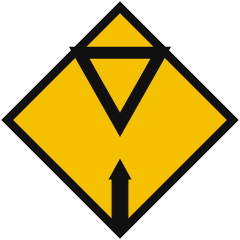
14. What will the driver have to do at the point this sign refers to?
Show answer
Answer C: Slow down and let conflicting traffic go first, stopping if that is what it takes
Further along, the driver has to let conflicting traffic and pedestrians go first, reducing speed and stopping whenever that is necessary to avoid interfering with them.
-
15. How does a full load of passengers and luggage affect your braking?
Show answer
Answer B: It lengthens the stopping distance, so you should brake earlier
More weight means more energy to get rid of, so a loaded vehicle takes longer to stop and needs earlier, gentler braking.
-
16. Which blood alcohol range is the Pennsylvania high rate tier?
Show answer
Answer B: .10 to .159
The Pennsylvania high rate tier runs from .10 to .159 and carries jail time, higher fines and a 12 month suspension with ignition interlock even for a first offense.
-
17. You are in the middle lane of a one-way street with three lanes when a police car approaches from behind with lights and siren. What should you do?
Show answer
Answer C: Pull to the nearest curb and stop clear of the lanes
On a one-way street you clear to whichever curb is closest, so the emergency vehicle gets a clear path down the open lanes.
-
18. A regulatory message is normally carried on a sign whose shape is
Show answer
Answer A: a rectangle standing taller than it is wide
Regulatory signs that state a law, such as speed limits and turn restrictions, use a vertical rectangle with a black legend on a white background.