
Pennsylvania PennDOT Motorcycle Practice Test 51
- Questions18
- Correct to pass15
- Passing score83%
- Minimum age16 years
-
1. Why do groups agree on a set of hand signals before setting off?
Show answer
Answer B: Because engine noise and helmets make speech useless between moving machines
Riders cannot talk to each other while moving, so agreed signals for hazards, stops, fuel and single file keep the whole group informed.
-
2. What happens if a Pennsylvania driver is stopped by police and cannot show a valid insurance ID card?
Show answer
Answer C: The officer cites the driver, and a conviction can suspend both the vehicle registration and the driver license
If a Pennsylvania driver cannot show a valid insurance ID card when stopped, the officer cites the driver, and a conviction can lead to suspension of both the vehicle registration and the driver license.
-
3. A traffic signal separates you from the rest of your group. What should you do?
Show answer
Answer B: Continue at a safe and legal pace and rejoin the group farther along
Staying with a group never justifies breaking a traffic law, so a separated rider proceeds normally and the group regroups at a planned point.
-
4. How should the mirrors be set before setting off?
Show answer
Answer B: So that each mirror shows the lane behind and part of the lane beside
Mirrors aimed too far inward show mostly the rider, wasting the view that is meant to cover the traffic behind and to the side.
-
5. Can a driver be charged with impaired driving after taking a legal over the counter medicine?
Show answer
Answer C: Yes, if the medicine impairs the ability to drive safely
Impaired driving laws cover any substance that affects driving, including cold remedies, allergy pills and sleep aids sold without a prescription.
-
6. How much more energy must your brakes absorb if you double your speed?
Show answer
Answer D: About four times as much, since energy rises with the square of speed
Kinetic energy grows with the square of speed, so twice the speed means about four times the energy and a far longer braking distance.
-
7. Where does a rider find the correct chain slack figure for a particular motorcycle?
Show answer
Answer B: In the owner manual for that motorcycle
Correct slack varies from model to model, so the manufacturer specification in the owner manual is the only reliable figure.
-
8. Why is smooth, early braking better than hard, late braking?
Show answer
Answer D: It keeps you in control and gives the driver behind more warning
Braking early and gently keeps the tires well within their grip and gives following drivers time to react to your brake lights.
-
9. You come around a bend and find loose sand spread across your lane. What should you do?
Show answer
Answer D: Ease off the gas, avoid sudden braking or steering, and keep straight
Loose material acts like ball bearings under the tires; smooth inputs preserve what little grip remains, while sudden braking or steering breaks it.
-
10. A United States numbered route is normally marked with
Show answer
Answer C: black numerals on a white shield
The U.S. route marker is a white shield carrying black numerals, which sets it apart at a glance from the red, white and blue Interstate shield.
-
11. You are about to pull out from a stop sign. Which scanning habit is correct?
Show answer
Answer A: Look to the left, then to the right, then to the left again before moving
Traffic from the left reaches you first, and a second look left catches anything that arrived while you were looking right.
-
12. Roughly how far does a vehicle travel at 55 mph during the few seconds a driver spends reading a text message?
Show answer
Answer D: About the length of a football field
Sending or reading a message takes the eyes off the road for about five seconds, which at 55 mph covers roughly the length of a football field with nobody watching the road.
-
13. What kind of sole and heel suit motorcycle boots?
Show answer
Answer A: A hard, slip resistant sole with a low heel that will not catch
Boots have to grip the pavement when you put a foot down and grip the footrests while you ride, and a tall heel can catch on the ground or on the machine.
-
14. You leave a brightly lit service area onto a dark rural road. Why should you slow down for a while?
Show answer
Answer C: Your eyes need time to adjust, so at first you see less
Eyes take a few minutes to adapt from bright light to darkness, and during that time you can see much less than your headlights actually show.
-
15. You brake hard on a wet road and need to steer around a stalled car. How do antilock brakes help you do that?
Show answer
Answer B: They stop the wheels locking, so the tires can still turn the vehicle
Locked wheels slide and cannot change direction. By preventing lockup the system lets you brake at full force and steer at the same time.
-
16. Which of these makes you unpredictable to other drivers?
Show answer
Answer B: Changing lanes suddenly without signaling, to save a moment
An unsignalled, sudden lane change gives nobody time to react and is a common cause of sideswipe collisions.
-
17. Which action becomes clearly more risky beyond this sign?
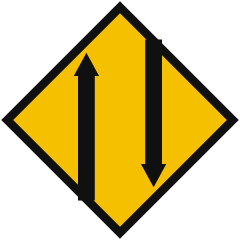
Show answer
Answer A: Using the left side of the roadway to overtake
With vehicles coming the other way on the same pavement, overtaking on the left needs enough clear road to pull out, pass and return, which is often not available.
-
18. You are on a city street with two lanes in your direction, cars parked along the curb and driveways every few yards. Which lane is usually safer?
Show answer
Answer B: The lane farther from the curb, away from opening doors and vehicles pulling out
Most of the hazards on such a street come from the curb side, so the inside lane gives you more space and more time to react.