
Pennsylvania PennDOT Motorcycle Practice Test 23
- Questions18
- Correct to pass15
- Passing score83%
- Minimum age16 years
-
1. How should a rider approach a curve whose radius keeps tightening the further you go into it?
Show answer
Answer A: Enter more slowly than the curve first appears to need, saving lean for the exit
In a decreasing radius curve the sharpest part comes last, so a slower entry leaves both speed and lean angle in reserve for where they are needed.
-
2. How can a Pennsylvania driver avoid a registration suspension after a short lapse in insurance coverage?
Show answer
Answer A: By obtaining new coverage within 31 days and providing an affidavit that the vehicle was not operated during the lapse
A Pennsylvania driver can avoid a registration suspension after a lapse by getting coverage back within 31 days and submitting an affidavit that the vehicle was not driven during the gap.
-
3. You arrive at an intersection with no signs, no signals and no markings at the same time as a vehicle on the road to your right. What must you do?
Show answer
Answer B: Yield to the vehicle on your right
At an uncontrolled intersection you must yield to a vehicle already in the intersection or approaching from your right.
-
4. Another driver is behaving aggressively toward you. What should you do?
Show answer
Answer D: Avoid eye contact, give them room to go on their way and do not respond to provocation
Responding to an aggressive driver escalates the conflict, while creating distance and refusing to engage takes you out of the situation. Report serious threats once you can do so safely.
-
5. On an undivided two-lane road you meet a school bus coming toward you with its red lights flashing and its stop arm out. What must you do?
Show answer
Answer C: Stop and wait until the red lights stop flashing
On an undivided road drivers in both directions must stop for a school bus loading or unloading, because children may cross in front of it.
-
6. A yellow diamond shows two lanes narrowing into one. What does it require of a driver?
Show answer
Answer D: Adjusting speed and merging before the lane disappears
The lane ends sign gives notice that one lane will be dropped, so drivers should adjust speed and blend into the continuing lane in good time.
-
7. This sign comes into view ahead of a driver who has already started along a ramp. What should the driver do?
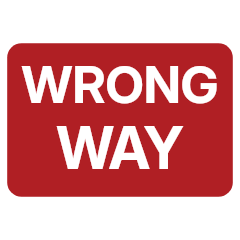
Show answer
Answer B: Pull clear where it is safe, then turn around and leave the ramp traveling properly
The driver is traveling against the legal flow, so the safest response is to stop clear of the lanes, turn the vehicle around and get off the ramp before meeting traffic head on.
-
8. A minor drop has left the clutch lever bent, although it still works. What should be done?
Show answer
Answer B: Have the lever replaced before the motorcycle is ridden again
A bent lever has already been weakened and can break off in use, leaving the rider without that control at the worst possible moment.
-
9. Which effect appears as a drinker's blood alcohol level climbs well past the first drinks?
Show answer
Answer D: Loss of muscle control and steady steering
Higher levels of alcohol reach the parts of the brain that control movement, which shows up as clumsy steering, late braking and poor lane control.
-
10. The vehicle you have borrowed is larger and heavier than your own. How should you drive it?
Show answer
Answer B: Allow more room for stopping and for turns until you are used to it
Extra weight and length mean longer stopping distances and wider turns, so give yourself more room until you are used to it.
-
11. What does an 8 restriction on a Pennsylvania motorcycle license mean?
Show answer
Answer A: The rider may not operate a motorcycle of more than 5 brake horsepower
Testing on a motorcycle of 5 brake horsepower or less places an 8 restriction on the Pennsylvania license, which bars the holder from operating anything more powerful.
-
12. What is the best path through a curve where you can see all the way to the exit?
Show answer
Answer A: Start toward the outside, move toward the inside, then drift back out
Entering wide, cutting toward the inside and running back out straightens the path, which means less lean angle for the same speed and a better view.
-
13. Is dictating a message by voice a safe alternative to typing one?
Show answer
Answer C: No, it still takes attention from driving
Composing and checking a spoken message loads the mind and usually pulls the eyes to the screen anyway, so research finds it no safer than other phone use.
-
14. Traffic in your lane is backed up and the paved shoulder looks clear. May you drive along it to get past?
Show answer
Answer C: No, the shoulder is not a travel lane
Passing must be done within the roadway; driving on the shoulder to get around traffic is prohibited and surprises anyone entering from the right.
-
15. A driver holds a steady highway speed into the section this sign warns about. What is the most likely result?
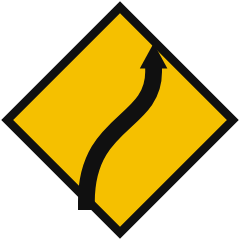
Show answer
Answer B: The vehicle runs wide toward the outside and can cross into another lane or leave the pavement
Holding speed into a change of alignment asks the tires for more side grip than they can supply, so the vehicle runs wide and the driver is left with less room to correct.
-
16. You are stopped in a shared through and right-turn lane with your right signal on, and a bicyclist rides up along your right side. What should you do?
Show answer
Answer A: Let the bicyclist clear the intersection or move ahead before you turn
A cyclist alongside your right side is in the path your turn will sweep across, so wait until that space is clear before turning.
-
17. When is it safe to return to your own lane after passing a vehicle?
Show answer
Answer C: Once you can see the whole front of that vehicle in your mirror
Seeing the entire front of the vehicle in the mirror proves there is a full vehicle length of clear road, which the rider cannot judge by feel alone.
-
18. The rear tire loses air suddenly while you are riding. Which symptom should you expect and how should you respond?
Show answer
Answer D: The rear sways or feels heavy, so ease off and slow with the front brake
A rear flat makes the back of the motorcycle wallow or sway, so hold your line, close the throttle gently and slow mainly with the brake on the wheel that still has air.