
Pennsylvania PennDOT Motorcycle Practice Test 13
- Questions18
- Correct to pass15
- Passing score83%
- Minimum age16 years
-
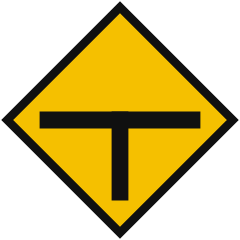
1. What must a driver be prepared to do at the point this sign refers to?
Show answer
Answer D: Turn left or right, because the road being traveled ends there
The road ends at another roadway, so the driver must slow, give way to traffic on the through road and turn in one direction or the other.
-
2. A mixed drink is made with two shots of spirits. How much alcohol is that?
Show answer
Answer C: About two standard drinks
A standard drink is a fixed amount of pure alcohol, so a glass poured with two measures counts as two drinks however it is served.
-
3. Your passenger wants to carry a bag in one hand during the ride. What should you tell them?
Show answer
Answer B: No, both hands are needed to hold on, so the bag must be secured on the machine
A passenger needs both hands on the operator or the handholds, and anything carried loose can be dropped into the wheel or pull the passenger off balance.
-
4. A vehicle is sitting in your blind spot and you need to change into that lane. What should you do?
Show answer
Answer B: Adjust your speed to open a clear gap, then check again and move over
Changing your speed either drops the other vehicle behind you or lets it move ahead, which turns the blind spot back into open space.
-
5. How do stimulant drugs such as amphetamines or cocaine typically affect driving?
Show answer
Answer D: They can make the driver overconfident and more willing to take risks
Stimulants create a false sense of alertness and encourage aggressive, risky driving. When they wear off, sudden fatigue can follow.
-
6. What minimum fine does Pennsylvania impose for a conviction of operating an uninsured vehicle, separate from any suspension?
Show answer
Answer C: 300 dollars
Pennsylvania imposes a minimum fine of 300 dollars for a conviction of operating an uninsured vehicle, in addition to the registration and license suspensions that follow.
-
7. What is the purpose of carrying a first aid kit in your vehicle?
Show answer
Answer D: It lets you treat cuts and bleeding while the help is on its way
A kit is for simple first aid such as controlling bleeding until trained help arrives, not a substitute for calling for that help.
-
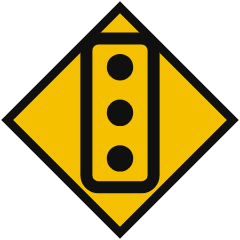
8. Why would this sign be installed on an approach?
Show answer
Answer B: Because the signal cannot be seen from far enough back for a driver to react in time
Advance notice of a signal is used where a crest, a curve, trees or a building keep the signal heads out of view until a driver is already too close to stop comfortably.
-
9. As you approach an intersection, what is a sound search pattern?
Show answer
Answer A: Look left, then ahead, then right, then left again before you enter
Traffic from the left reaches the rider first, so it is checked first and then rechecked, with the road ahead and the traffic from the right covered in between.
-
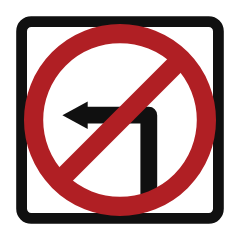
10. A driver in the leftmost lane reaches this sign at an intersection. What must the driver do?
Show answer
Answer B: Go straight on or turn right, and reach the destination another way
The restriction holds whatever the traffic or the signal is doing, so the driver has to pass the intersection and plan a different route.
-
11. Besides a chemical test, what else supports an impaired driving charge?
Show answer
Answer B: The officer's observations of the driving and the driver
Weaving, slow responses, speech and balance observed by the officer are evidence in their own right, which is why a driver can be charged on behavior alone.
-
12. You are in the middle of an intersection when you hear a siren and see an emergency vehicle approaching. What should you do?
Show answer
Answer A: Keep going, clear the intersection, then pull to the right and stop
Stopping inside an intersection blocks the emergency vehicle. Clear the intersection first, then pull over to the right and stop.
-
13. Which color scheme is standard for the drums and barricades that channel traffic through a work zone?
Show answer
Answer C: Alternating orange and white retroreflective stripes
Drums and barricades carry alternating orange and white retroreflective stripes, and the traffic cones used in the same zones are predominantly orange.
-
14. A piece of farm machinery ahead of you is wider than its own lane. What should you do?
Show answer
Answer C: Hold back until you can see far enough to pass safely
Wide equipment leaves no gap inside the lane and may use part of the other side, so a pass needs a long clear view of the road ahead.
-
15. What is the main danger of grabbing the front brake lever abruptly?
Show answer
Answer D: The front wheel can lock, and a locked wheel cannot steer or balance
The front brake must be squeezed progressively so that weight transfers onto the front tire before full braking force is asked of it.
-
16. Before making a U-turn on a narrow street, what should the rider do first?
Show answer
Answer A: Check that the street is wide enough and clear in both directions
A U-turn commits the rider to crossing both directions of traffic in a space the machine may not fit into, so both the width and the traffic are judged before starting.
-
17. As a driver keeps drinking, in what order are driving abilities usually lost?
Show answer
Answer C: Judgment, then vision, reaction time and coordination
Alcohol reaches the parts of the brain that handle judgment first, and only later does it visibly affect sight, reactions and muscle control.
-
18. You stop behind another vehicle at a traffic light. How much space should you leave?
Show answer
Answer D: Enough to see where its rear tires touch the pavement
Seeing the rear tires on the road leaves room to steer around the vehicle if it stalls, and gives a cushion if you are struck from behind.