
Pennsylvania PennDOT Permit Practice Test 61
- Questions18
- Correct to pass15
- Passing score83%
- Minimum age16 years
-
1. Which facility does this sign direct a traveler toward?

Show answer
Answer B: A hospital offering emergency care
This is the standard marker for medical care, used to lead a traveler to a hospital where emergency treatment is available.
-
2. You are making a U-turn at a signal on a green left arrow. Who must you still watch for?
Show answer
Answer D: People in the crosswalk you will cross as you come around
Even a protected arrow does not clear the crosswalk, and a U-turn sweeps across a crosswalk that pedestrians may already be using.
-
3. The brake warning light stays on even though the parking brake is fully released. What does it indicate?
Show answer
Answer B: A possible brake system problem, so have the brakes checked promptly
The brake warning light also signals low brake fluid or a failure in one part of the hydraulic system. Do not ignore it, because braking may be reduced.
-
4. What is the usual result of driving well above the flow of traffic on a typical trip?
Show answer
Answer B: Very little time saved, with much greater risk
Signals, traffic and short distances swallow the theoretical gain, while crash risk and crash severity both climb sharply with speed.
-
5. How far must a Pennsylvania driver stay clear when passing a bicyclist on the roadway?
Show answer
Answer A: At least 4 feet
Pennsylvania requires a driver to allow at least 4 feet of clearance when passing a bicyclist, and prohibits forcing a cyclist off the road.
-
6. At an intersection that uses a lagging left turn, when is the left-turn arrow displayed?
Show answer
Answer B: After the through movement has run
A lagging left turn phase runs at the end of the green rather than the start, so a driver waiting to turn should not assume the arrow has been missed.
-
7. What is the safest way to pass a bicyclist on a road with two lanes going your way?
Show answer
Answer D: Change lanes completely, as you would for a car
A bicycle is entitled to the room a vehicle needs, and moving into the next lane gives the rider space to swerve around a drain or a pothole.
-
8. Why should your thumbs rest along the rim rather than hook inside the spokes?
Show answer
Answer D: A jolt can spin the wheel and injure hooked thumbs
A pothole or a dropped wheel can snap the wheel round violently, and thumbs hooked through the spokes are trapped when it happens.
-
9. What extra consequence follows a second offense of operating a Pennsylvania vehicle without a required ignition interlock device?
Show answer
Answer D: A 1 year license suspension plus an additional 1 year of ignition interlock
A second offense of illegally operating a vehicle without a required ignition interlock adds a 1 year license suspension plus another 1 year ignition interlock requirement.
-
10. You are approaching the entry of a modern roundabout. Who must you yield to?
Show answer
Answer C: Traffic already circulating in the roundabout, which approaches from your left
Traffic in a United States roundabout circulates counterclockwise, so drivers entering must look left and yield to vehicles already in the circulating roadway.
-
11. Your right wheels have dropped onto a soft shoulder. Why should you not steer straight back onto the pavement?
Show answer
Answer A: The tires can catch the pavement edge and throw you across the road
A tire pressed against the edge of the pavement climbs it suddenly, and at speed that jolt can send the vehicle across the center line.
-
12. A driver reaches this sign and the intersecting roadway is completely clear. What is required?
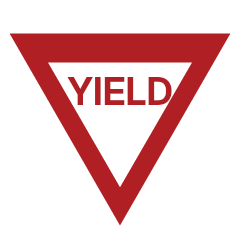
Show answer
Answer D: Slowing to a speed that allows stopping, then going on without stopping if the way stays clear
This control asks the driver to slow down and be ready to stop, and a full stop becomes necessary only when traffic or pedestrians would otherwise be interfered with.
-
13. When did Pennsylvania's law prohibiting text based communications while driving take effect?
Show answer
Answer D: March 8, 2012
Pennsylvania's anti-texting law took effect on March 8, 2012.
-
14. A freeway sign shows a minimum speed limit. What does it require?
Show answer
Answer B: That you keep up with it unless conditions make that unsafe
A minimum speed limit keeps very slow vehicles off the highway, but weather, traffic or a mechanical problem may make a lower speed necessary and lawful.
-
15. How does a lap and shoulder belt protect you in a crash?
Show answer
Answer B: It holds you to the seat and spreads the force over the strong bones
The belt keeps you with the vehicle as it slows and puts the load on the hips and the chest rather than on soft tissue.
-
16. You are overtaking in a short passing lane on a two-lane road and it is about to end. What must you do?
Show answer
Answer A: Finish the pass and move back to the right before it ends
The added lane ends and the traffic returns to a single lane in each direction, so the pass has to be complete before the pavement runs out.
-
17. You see an open curb space on the opposite side of a two-way street. What should you do?
Show answer
Answer B: Drive on, turn around, and come back on that side
You must park on the right, facing the direction of travel, so reaching a space on the other side means going around rather than crossing into it.
-
18. Why do young drivers carrying several friends face a higher crash risk?
Show answer
Answer D: Because young passengers are a strong source of distraction and pressure
Crash risk for new drivers rises with each extra young passenger, mainly through distraction and social pressure.