
Pennsylvania PennDOT Permit Practice Test 59
- Questions18
- Correct to pass15
- Passing score83%
- Minimum age16 years
-
1. What is the default Pennsylvania statutory speed limit in an urban district unless a different limit is posted?
Show answer
Answer B: 35 mph
Pennsylvania's Vehicle Code sets the default maximum speed in an urban district at 35 mph unless a different limit is posted.
-
2. You carry reflective warning triangles in your car. How should they be used after a breakdown?
Show answer
Answer B: Set out behind the vehicle, far enough back to warn traffic before it arrives
A warning device works only if drivers see it in time to react, so it is placed well back along the road they are traveling.
-
3. A school sign paired with a plaque showing a diagonal downward-pointing arrow is installed
Show answer
Answer D: at the school crossing itself, or as close to it as possible
The diagonal downward arrow points at the crossing, so this assembly is placed at the crossing location rather than in advance of it.
-
4. You are towing a trailer and turning right at an intersection. What must you allow for?
Show answer
Answer D: The trailer cuts the corner, so swing wider than usual
A trailer follows a shorter path than the towing vehicle, so its wheels track inside your line and can mount the curb unless you take the turn wide.
-
5. You are traveling beside a solid white lane line. What does it tell you?
Show answer
Answer B: Crossing it is discouraged or prohibited, so stay in your lane
A solid white line separates lanes going the same direction where lane changing is discouraged or prohibited, such as where a through lane meets a mandatory turn lane.
-
6. Where is the best place in the car for a child safety seat?
Show answer
Answer A: In the rear seat, secured either with the belt or with the lower anchors
The rear seat is furthest from most impacts and from the front airbags, and the seat must be locked in with the belt or the anchors.
-
7. What is the proper use of the horn?
Show answer
Answer C: To give a brief warning when another road user may not have seen you
The horn is a warning device meant to alert someone to your presence when a collision is possible, and using it in anger tends to escalate conflict rather than prevent crashes.
-
8. You are the first driver on a road just after a storm. What should you plan for?
Show answer
Answer B: Branches, mud and other debris hidden around the next bend
Storm debris lands where nobody has cleared it yet, often just beyond a curve or a crest, so reduce speed and look much further ahead.
-
9. What is the correct relationship between air bags and seat belts?
Show answer
Answer B: Air bags are designed to work together with seat belts, not instead of them
An air bag is a supplemental restraint that cushions one impact, while the belt keeps you in position so the bag can work and protects you in rollovers and secondary impacts.
-
10. When should headlights be switched on besides during the hours of darkness?
Show answer
Answer C: Whenever rain, fog, snow or dust makes it harder to see or to be seen
Headlights are as much about being seen as about seeing, so they go on whenever visibility drops.
-
11. Which sign tells you that the vehicles ahead are part of a funeral procession?
Show answer
Answer C: Headlights burning in daylight, with small flags or markers on the vehicles
Processions are normally identified by daytime headlights, hazard lights and flags or windshield markers, not by emergency lights or sirens.
-
12. A driver is following you far too closely and you have a turn coming up. How should you slow down for it?
Show answer
Answer B: Signal early and slow gradually well before the turn
Early signals and gentle braking give a tailgater the time and distance they have failed to leave for themselves.
-
13. What does a NARROW BRIDGE warning sign tell a driver?
Show answer
Answer A: The bridge is tighter than the road leading up to it
A narrow bridge still carries both directions, but with much less clearance than the approaches, so drivers should slow and hold their lane position carefully.
-
14. Two lanes at the corner are marked for right turns. What does that require of you?
Show answer
Answer A: Keep your own lane through the turn and into the matching new lane
Dual turn lanes work only if each vehicle stays in its own lane all the way round and finishes in the corresponding lane of the new street.
-
15. You have begun to move into the next lane when the gap you were aiming for closes. What is the safest action?
Show answer
Answer C: Return to your own lane, cancel the signal and wait for a better gap
An unfinished lane change leaves you in a space that no longer exists, and the lane you came from is still yours.
-
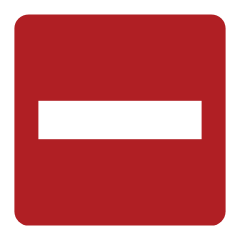
16. At which location is this sign normally installed?
Show answer
Answer D: Facing traffic that could turn into a one-way roadway or ramp against the flow
It is posted where a driver could otherwise enter a ramp or a one-way roadway from the wrong end, so it faces exactly the traffic that has to be kept out.
-
17. Why does a long downhill grade lengthen the distance you need to stop?
Show answer
Answer C: Because gravity keeps pulling the vehicle forward as you brake
On a downgrade gravity works with the vehicle and against the brakes, so the same speed needs noticeably more distance than it would on level ground.
-
18. Why should cruise control be switched off on wet, snowy or icy roads?
Show answer
Answer B: It may keep feeding power to a wheel that has started to slip, and cancelling it costs you time
Cruise control holds a set speed regardless of grip, so it can add power just as a tire loses traction, and the extra step of cancelling it delays your response.