
Pennsylvania PennDOT Permit Practice Test 50
- Questions18
- Correct to pass15
- Passing score83%
- Minimum age16 years
-
1. At an intersection where turning on a red arrow is not permitted, the signal shows a red left arrow next to a steady green ball. What may you do?
Show answer
Answer D: Go straight or turn right if permitted, but not left
An arrow controls only the movement it points to, so here the red arrow stops the left turn while the green ball still allows the other movements.
-
2. Where is a U-turn most clearly unsafe and generally prohibited?
Show answer
Answer D: On a curve or near a hill crest, where other drivers cannot see you
U-turns are barred where approaching drivers cannot see you in time, such as on a curve or near the top of a hill.
-
3. Another driver has pulled out to pass you. What should you do?
Show answer
Answer A: Stay in your lane, keep your speed steady or ease off, and let the pass finish
Accelerating while being passed forces the other driver to stay in the opposing lane longer, so the safe response is to hold or slightly reduce speed and stay right.
-
4. How should speed and following distance be adjusted beyond this sign?
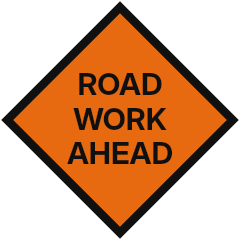
Show answer
Answer D: Cut speed and leave a longer gap, because traffic can stop without warning
Traffic in these areas stops and starts unexpectedly and there is little room to steer around a problem, so extra space is what prevents a rear-end collision.
-
5. A sign at the intersection prohibits U-turns, but the opening looks wide and clear. What may you do?
Show answer
Answer B: Obey the sign and turn around somewhere else
A prohibition applies whatever the traffic looks like at that moment, usually because of sight distance or conflicts you cannot see from the lane.
-
6. Your light turns green, but a vehicle is still in the middle of the intersection. What should you do?
Show answer
Answer D: Wait until the intersection is clear before you move ahead
A green light means go only when the way is clear. Drivers already inside the intersection must be allowed to finish crossing.
-
7. You are driving on a road covered with a layer of wet fallen leaves. What should you expect?
Show answer
Answer B: As little grip as on ice, plus hidden markings and hidden holes
Wet leaves are as slippery as ice and they hide the lane lines and any potholes underneath, so slow well before curves and stops.
-
8. What do two solid yellow lines down the middle of a two-way road mean?
Show answer
Answer D: Passing is prohibited for traffic in both directions
A double solid yellow line marks a two-direction no-passing zone, so neither direction may cross it to overtake another vehicle.
-
9. You have just returned to your own lane after passing. Why should you not slow down straight away?
Show answer
Answer A: The vehicle you passed is close behind and needs room to stop
Returning and then braking leaves the driver you just overtook with almost no following distance, which is how a pass turns into a rear-end collision.
-
10. A driver ignores this sign and passes on the opposite side. What is the main risk?
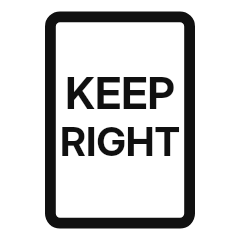
Show answer
Answer B: Ending up on the wrong side of a divider, facing traffic coming the other way
The sign settles which side of a fixed divider is the legal one, so taking the other side sends the vehicle into the opposing stream or straight at the obstruction.
-
11. A snow squall cuts visibility to almost nothing while you are on a highway. What must you not do?
Show answer
Answer D: Stop in a travel lane and wait for the squall to blow through
A vehicle stopped in a lane in a whiteout is invisible until someone hits it. Slow gradually and keep moving until you can leave the roadway completely.
-
12. Where is the safest place for children under 13 to ride?
Show answer
Answer C: In the back seat
The back seat keeps children away from the force of a deploying front air bag and is farther from the most common impact area, which is why it is recommended through at least age 12.
-
13. You are turning left from a two-way street onto a one-way street. Which lane should you enter?
Show answer
Answer C: The first lane open to traffic on the left side of the one-way street
Turn left from the lane closest to the center line and finish in the first available lane on the left of the one-way street, then change lanes if you need to.
-
14. A high truck ahead of you hides the traffic signal as you approach the intersection. What should you do?
Show answer
Answer A: Drop back so you can see the signal and the truck's brake lights
Extra following distance restores your view of the signal, so you are reacting to the light yourself rather than copying the truck driver.
-
15. What is the only reliable remedy for a driver who is sleepy?
Show answer
Answer A: Sleep
Caffeine, fresh air and noise may make you feel alert for a few minutes, but they do not remove the need for sleep. Stop somewhere safe and rest.
-
16. You have passed a large truck and want to move back into its lane. What should you see first?
Show answer
Answer B: Both of its headlights in your rear-view mirror
Seeing both headlights in your mirror means you are far enough ahead to be out of the truck's front no-zone before you move over.
-
17. Some crosswalks are marked with two transverse lines and others with a row of wide bars laid along the direction of travel. Why is the second pattern used?
Show answer
Answer B: It is far easier for an approaching driver to see
Longitudinal bar patterns are used where extra visibility is wanted, such as an uncontrolled crossing or one near a school, because they show up much better from a car.
-
18. Traffic is backed up just past the exit you want to use at a single-lane roundabout. What should you do?
Show answer
Answer D: Wait at the yield line until you can pass through and exit
You must not enter a roundabout unless you can clear it, because stopping inside blocks every other entry.