
Pennsylvania PennDOT Permit Practice Test 47
- Questions18
- Correct to pass15
- Passing score83%
- Minimum age16 years
-
1. Red pavement markings are used on a roadway to show that
Show answer
Answer A: it must not be entered from that direction
Red markings identify a roadway that is not to be entered or used, and they also mark the pavement of truck escape ramps.
-
2. A rectangular marker with alternating black and retroreflective yellow stripes set at a slant is used to
Show answer
Answer C: mark an obstruction, with the stripes sloping down toward the side on which traffic should pass
This striped panel is an object marker, and the direction in which the stripes slope shows the driver which side of the obstruction to pass on.
-
3. What night driving restriction applies to a Pennsylvania junior driver's license holder?
Show answer
Answer B: No driving between 11:00 p.m. and 5:00 a.m. unless accompanied by a parent, guardian or spouse 18 or older
A Pennsylvania junior driver may not drive between 11:00 p.m. and 5:00 a.m. unless accompanied by a parent, guardian or spouse age 18 or older, with limited exceptions for documented employment and emergency service.
-
4. A wide crosswalk you are turning across has a refuge island in the middle. What should you assume about people standing on it?
Show answer
Answer D: They may step off the island into your path at any moment
An island is a pause in a crossing, not the end of one, so treat anyone on it as a pedestrian who is still crossing.
-
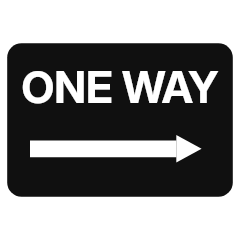
5. A driver on the street this sign governs is preparing to turn left at the next corner. Which lane should the vehicle be in beforehand?
Show answer
Answer A: The lane closest to the left curb
All the traffic here runs the same way, so nothing is coming toward the driver and the turn is taken from the extreme left lane rather than from beside the middle of the roadway.
-
6. The lights at a highway-rail grade crossing begin to flash red as you approach. What must you do?
Show answer
Answer B: Stop short of the tracks and wait until the lights stop and no train is near
Flashing red lights at a crossing require a stop clear of the tracks, and you may proceed only once the lights have stopped, any gates are fully raised and no train is approaching.
-
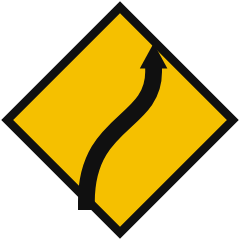
7. What does this sign tell a driver about the road ahead?
Show answer
Answer A: The roadway changes direction ahead, so speed should be reduced before reaching it
It gives advance notice of a change in alignment so the driver can slow down before entering, since braking inside a bend uses up grip that is needed for steering.
-
8. You have just been involved in a crash on a city street. Which sequence of first steps is correct?
Show answer
Answer A: Stop where you are, check everyone for injuries, and then make the scene safe
You are required to stop, and the first priority at the scene is people, followed by preventing a second collision.
-
9. Two roads come together at a shallow angle under a MERGE sign, with no yield line on either one. What is expected of you?
Show answer
Answer D: Adjust your speed and position so you blend smoothly into the other traffic
A merge means neither road ends at a stop; drivers adjust speed and position so that the two streams fit together without stopping.
-
10. You are stopped at a stop sign waiting to turn onto a highway where traffic moves at 55 mph. How should you choose your gap?
Show answer
Answer A: Wait for a much larger gap than the one you would accept on a city street
Fast traffic covers ground while you are still accelerating, so the gap that feels adequate at 25 mph is dangerously short at highway speed.
-
11. Besides its height, what else matters about a head restraint?
Show answer
Answer C: That it is close to the back of the head, and not far behind it
A restraint that sits far behind the head lets the head snap back before it is caught, so a small gap is important.
-
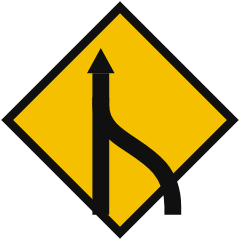
12. Why does the situation ahead of this sign deserve extra care from a motorcyclist?
Show answer
Answer C: Because a narrow machine is easy to overlook in a mirror or a blind spot
A motorcycle fills very little of a mirror and disappears easily into a blind spot, so the rider should adjust speed and lane position to stay visible where the streams come together.
-
13. A rear tire blows out on the highway. How does the vehicle usually behave?
Show answer
Answer C: The back end weaves or fishtails from side to side
A rear failure shows up as the tail wandering rather than a pull on the steering, so hold the wheel straight and let the speed drop gradually.
-
14. What seat belt rule applies specifically to Pennsylvania drivers under 18?
Show answer
Answer B: They may not carry more passengers than there are seat belts in the vehicle
A Pennsylvania driver under 18 may not transport more passengers than the vehicle has seat belts, on top of the general seat belt requirements.
-
15. Which clue tells you that a parked vehicle is about to pull into traffic?
Show answer
Answer D: Exhaust smoke, brake lights, front wheels turned out or a driver in the seat
A running engine, lit brake lights, turned wheels or a person behind the wheel all mean the vehicle may move. Slow down and give it room.
-
16. What penalty follows a Pennsylvania conviction for failing to stop for a school bus with flashing red lights and an extended stop arm?
Show answer
Answer D: A 60 day license suspension, five points and a fine
Pennsylvania imposes a 60 day suspension of the driver's license, five points on the record and a fine for failing to stop for a school bus with red lights flashing and stop arm extended.
-
17. Your loaded vehicle weighs more than the figure shown on a posted weight limit sign. What must you do?
Show answer
Answer D: Find another route, because crossing is not permitted
A posted weight limit is a legal maximum, not advice, so an overweight vehicle has to take a different route.
-
18. A pedestrian is crossing a wide four-lane street and has reached the lanes on the far side. When may you go on?
Show answer
Answer C: Only after the person has finished crossing the roadway
Waiting until the pedestrian has finished crossing is correct in every state and removes any doubt about how much clearance your state demands.