
Pennsylvania PennDOT Permit Practice Test 4
- Questions18
- Correct to pass15
- Passing score83%
- Minimum age16 years
-
1. Well before an intersection, an overhead sign shows a diagram of the lanes with an arrow above each one. What is its purpose?
Show answer
Answer C: To let drivers pick the correct lane in good time
Advance intersection lane control signs display the lane assignment far enough back that drivers can move over calmly instead of at the last moment.
-
2. You are driving on a rural road with no sidewalk. Where should you expect to meet pedestrians?
Show answer
Answer A: Walking toward you on your side of the road
Where there is no sidewalk, pedestrians are taught to walk facing traffic, so they appear on your side of the road coming toward you.
-
3. You are driving through a residential area where parked cars hide the side streets. What is the safest approach?
Show answer
Answer C: Slow down and cover the brake as you pass each opening
Where parked vehicles hide side streets and driveways, lower speed and a covered brake buy the time you lose in sight distance.
-
4. You are slowing to turn right at an intersection and a bicyclist is riding beside your right side in a bike lane. What should you do?
Show answer
Answer D: Let the bicyclist go through the intersection before you begin the turn
Turning across the path of a bicyclist who is going straight causes the classic right-hook crash. The rider continuing straight has the right-of-way over your turn.
-
5. A small plate under a stop sign reads CROSS TRAFFIC DOES NOT STOP. What is it telling you?
Show answer
Answer D: Traffic on the cross street is not required to stop at all
The plate warns that the other road is uncontrolled, so you must wait for a gap instead of expecting anyone to take turns with you.
-
6. Why does safety guidance say a child should ride in the back seat rather than in front of an active passenger airbag?
Show answer
Answer D: Because the airbag inflates with enough force to injure a small child badly
Airbags deploy at very high speed and are sized for adults, so a child seated close to one can be badly hurt by the bag itself, which is why the back seat is recommended for children.
-
7. In a work zone a flagger signals you to stop, but the sign beside the road says the lane is open. What should you do?
Show answer
Answer C: Obey the flagger
A flagger controls the work zone in real time and the instruction outranks the signs and markings, which cannot reflect what is happening at that moment.
-
8. The trapezoid sign shape is associated with
Show answer
Answer C: recreational and cultural interest area signing
The trapezoid is used for recreational and cultural interest area guide signs and for national forest route markers.
-
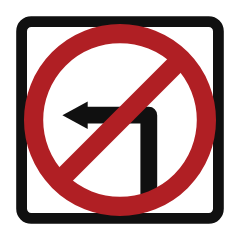
9. No plaque stating days or hours accompanies this sign at the intersection. When does the restriction apply?
Show answer
Answer D: At all times, since nothing limits it to particular periods
A regulatory restriction runs continuously unless a supplemental plaque states the days or hours during which it applies.
-
10. Why is it worth planning your route before a long drive?
Show answer
Answer B: So that you are not reading a map or a screen while the car is moving
A driver who knows the route is not navigating at the wheel, which is one of the commonest sources of distraction.
-
11. You realize you have just gone past your exit on a freeway. What should you do?
Show answer
Answer C: Carry on to the next exit and turn around there
A missed exit costs a few minutes, while backing up or cutting across the striped gore area puts you in the path of traffic that is not expecting it.
-
12. A person with a guide dog is standing at the corner facing the street you are about to cross. What should you do?
Show answer
Answer D: Stop well back and wait quietly for them to decide
Blind pedestrians rely on engine sound to judge traffic, so stop back from the crossing and avoid the horn, which only confuses them.
-
13. Your wiper blades smear the windshield instead of clearing it. What should you do?
Show answer
Answer C: Replace the blades, because smearing means that the rubber is worn
Worn or hardened rubber cannot wipe cleanly, and blades are cheap compared with driving without a clear view.
-
14. In slow summer traffic the temperature gauge climbs into the red. What should you do first?
Show answer
Answer A: Turn off the air conditioner and turn on the heater to draw heat from the engine
The heater core acts as an extra radiator, and shutting off the air conditioner reduces engine load. If the gauge keeps climbing, pull over and shut off the engine, and never open a hot radiator cap.
-
15. A trailer that sways badly at speed is often loaded the wrong way. What is the usual fault?
Show answer
Answer A: Too much of the load sits behind the trailer axle
Weight behind the axle lightens the hitch and lets the trailer wag the vehicle. Most of the load should sit ahead of the axle to keep weight on the hitch.
-
16. A yellow curve warning sign carries a yellow plaque showing a speed. What does that number mean?
Show answer
Answer D: The recommended maximum safe speed for the curve under ideal conditions
An advisory speed plaque on a yellow warning sign gives the recommended maximum speed for the hazard ahead when conditions are good.
-
17. A driver ahead of you extends the left arm straight out horizontally through the window. What is being signaled?
Show answer
Answer C: A left turn
The left arm held straight out is the standard hand signal for a left turn.
-
18. You wait in the aisle with your signal on for a space that is about to be vacated. What is the risk?
Show answer
Answer D: You block the aisle and drivers behind may try to squeeze past
A stopped vehicle turns a two-way aisle into a bottleneck, and drivers who try to get around it pass close to pedestrians and reversing cars.