
Pennsylvania PennDOT Permit Practice Test 18
- Questions18
- Correct to pass15
- Passing score83%
- Minimum age16 years
-
1. The red lights on a stopped school bus go out and the bus begins to move away. What should you do?
Show answer
Answer B: Move off slowly and keep watching for children near the road
Children who have just left the bus may still be near the roadway or crossing behind it, so pull away gently and keep looking for them.
-
2. A lane is marked with a large white bicycle symbol and chevrons, but there is no separate bicycle lane. What does it mean?
Show answer
Answer A: Bicyclists may use the whole lane, so follow or pass with care
A shared lane marking shows that bicyclists and drivers use the same lane and positions riders away from parked car doors, so passing means changing lanes.
-
3. The signal ahead has a sign prohibiting left turns, and your route needs a left. What should you do?
Show answer
Answer D: Go straight on and find a legal place to turn and come back
A turn prohibition applies to every driver, so you continue through and reach your route by another legal turn.
-
4. A motorcycle ahead of you has its turn signal blinking but continues straight through several intersections. What is the likely explanation?
Show answer
Answer D: Motorcycle signals often do not cancel themselves after a turn
Many motorcycle turn signals are not self-cancelling, so a rider may leave one on by mistake. Wait until the rider actually starts to turn before you act on the signal.
-
5. A yellow lamp flashes above a warning sign at a sharp curve. What does it ask of a driver?
Show answer
Answer D: Slow down and pass the point with extra care
A warning beacon draws attention to the sign it is mounted with, and the message of the sign is what the driver must act on.
-
6. When should you move into the lane you need for a turn?
Show answer
Answer D: Well before the intersection, as soon as you know your route
Getting into the correct lane early lets other drivers read your intentions and keeps you from making a sudden lane change at the corner.
-
7. A front tire blows out at highway speed. What should you do?
Show answer
Answer B: Hold the wheel firmly, ease off the accelerator and slow gradually before leaving the road
A blowout pulls the vehicle toward the failed tire, and hard braking or sharp steering can turn that pull into a spin, so a firm grip and gradual slowing keep the vehicle straight.
-
8. You are in the right-hand lane of a multilane street and that lane becomes a right-turn-only lane ahead, but you want to go straight. What should you do?
Show answer
Answer B: Change into a through lane before you reach the markings for the turn lane
A lane-use arrow is a regulatory marking, so a driver who wants to continue straight has to leave that lane before it becomes a mandatory turn lane.
-
9. Where is a strong crosswind most likely to hit you suddenly?
Show answer
Answer D: Coming out of a tunnel or a cut onto an open bridge
Gusts arrive the moment you leave shelter, which is why bridge approaches and the ends of cuts and tunnels catch drivers out.
-
10. What penalty applies to a first offense of illegally operating a Pennsylvania vehicle that is required to have an ignition interlock device but does not?
Show answer
Answer C: A fine of 300 to 1,000 dollars and up to 90 days imprisonment
A first offense of operating a Pennsylvania vehicle without a required ignition interlock device carries a fine of 300 to 1,000 dollars and up to 90 days of imprisonment.
-
11. An exit ramp is separated from the highway by a triangle of pavement painted with white stripes. What may you do there?
Show answer
Answer C: Nothing; keep off it and choose either the lane or the ramp
The striped area between a ramp and the through lanes is not for driving, stopping or last-second changes of direction.
-
12. At a freeway exit ramp, this sign normally backs up which other regulatory sign posted nearer to the ramp terminal?
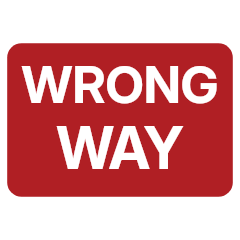
Show answer
Answer D: The sign that forbids entering that roadway at all
The two work as a pair at ramp terminals: one keeps drivers from turning in, and this one sits farther along to catch a driver who has already entered.
-
13. When should you turn on your signal before a turn or a lane change?
Show answer
Answer C: Well before the maneuver, so other drivers have time to react
A signal is a warning to others, so it has to be given far enough ahead of the maneuver that drivers and pedestrians can adjust.
-
14. A steady green downward arrow is displayed above the lane you are in. What does it tell you?
Show answer
Answer A: You may drive in that lane
A green downward arrow means the lane beneath it is open for travel in your direction.
-
15. The low sun is directly ahead and glare makes it hard to see. What should you do?
Show answer
Answer C: Slow down, use the sun visor or sunglasses, and increase following distance
Sun glare can hide pedestrians, brake lights and signals. Reducing speed and adding space gives you time to react to what you cannot yet see.
-
16. What speed limit applies to an open bed pickup or flatbed truck in Pennsylvania if an adult passenger, not a child, is riding in the open bed?
Show answer
Answer A: The truck may not be driven faster than 35 mph
Pennsylvania law bars an open bed pickup or flatbed truck from being driven faster than 35 mph whenever any person is occupying the open bed.
-
17. For how long is a Pennsylvania certificate of emission inspection normally valid?
Show answer
Answer D: No more than 15 months, and no less than 6 months
A Pennsylvania certificate of emission inspection is generally valid for no more than 15 months, and no less than 6 months, based on the vehicle's registration month.
-
18. In near freezing weather, which part of an otherwise clear road is most likely to still be icy?
Show answer
Answer D: A shaded dip under trees or beside a rock cut
Sun clears most of the road, but shaded hollows never warm up and can hold ice long after the rest of the pavement is dry.